Background Check for Hiring: A Step by Step HR Guide for UK, India, and Global Roles (2026)
A new hire starts on Monday. By Thursday, your team finds a major issue. Their last employer cannot confirm employment. Their degree cannot be verified. Compliance risk arises after access has already been granted. This is not just a hiring mistake. It is a verification gap.
A background check confirms identity and verifies key claims. It can also include right-to-work status, criminal records, sanctions, or licence validation. What you run depends on the role and local rules. Most employers use background checks to avoid surprises before granting access to people, money, systems, or sensitive locations.
Table of contents
- What is a background check, and why does the order of checks matter?
- What does a background check include?
- Background check for employment: what should HR verify first?
- Pre-employment background check workflow that scales
- Smart background check: risk-based screening in practice
- Advanced background check: when deeper screening is needed
- Cyber background check: when digital risk checks make sense
- UK background checks: DBS levels and what level 2 means
- International background checks: what changes by country
9.1 How do companies do background checks in India? - Fast background check: how to reduce turnaround time without losing accuracy
- Background check software: what it should do and what to ask vendors
- Background check companies: how to choose a provider
- FAQs
What is a background check, and why does the order of checks matter?
A background check helps employers confirm a candidate's history. It usually covers employment, education, qualifications, and certifications. For some roles, it can also include criminal record checks, sanctions screening, or credit checks where lawful.
The order matters because identity supports everything else. If the identity is incorrect or unclear, later checks may be run on the wrong person. That leads to wasted time, higher cost, and weak decisions.
A simple sequence works well in most hiring markets.
- Confirm identity first.
- Verify core claims next.
- Add additional risk checks last.
This order reduces rework. It also makes decisions easier to explain to candidates and auditors.
What does a background check include?
A background check is a set of checks, not one check. The best approach is to match checks to risk and access levels.
Most employers start with a baseline that stays consistent across the same job type.
- Identity verification
- Employment verification
- Education verification
After that, HR adds extra checks when they are relevant and lawful. These may include right-to-work checks, criminal record screening for eligible roles, sanctions screening, licence validation, references, credit checks for certain finance roles, and digital risk checks for high-access roles. If you offer packaged checks, you can describe this approach as background verification that scales, supported by background screening services that adapt to risk.
Background check for employment: what should HR verify first?
HR teams work better with a short, repeatable process. It reduces disputes and keeps hiring moving.
Start with identity. Then complete the required right-to-work checks and record the results properly. After that, confirm employment history and education. Validate licences when required by the role. Add deeper checks last, such as a DBS check, sanctions screening, credit checks where lawful, or digital risk checks. Use clear outcome labels so the next step is obvious. Verified means evidence supports the claim. Unverifiable means the source cannot confirm it, so HR requests alternate evidence or documents it as unverifiable. A discrepancy indicates a mismatch and requires a structured review and a recorded decision.
Pre-employment background check workflow that scales
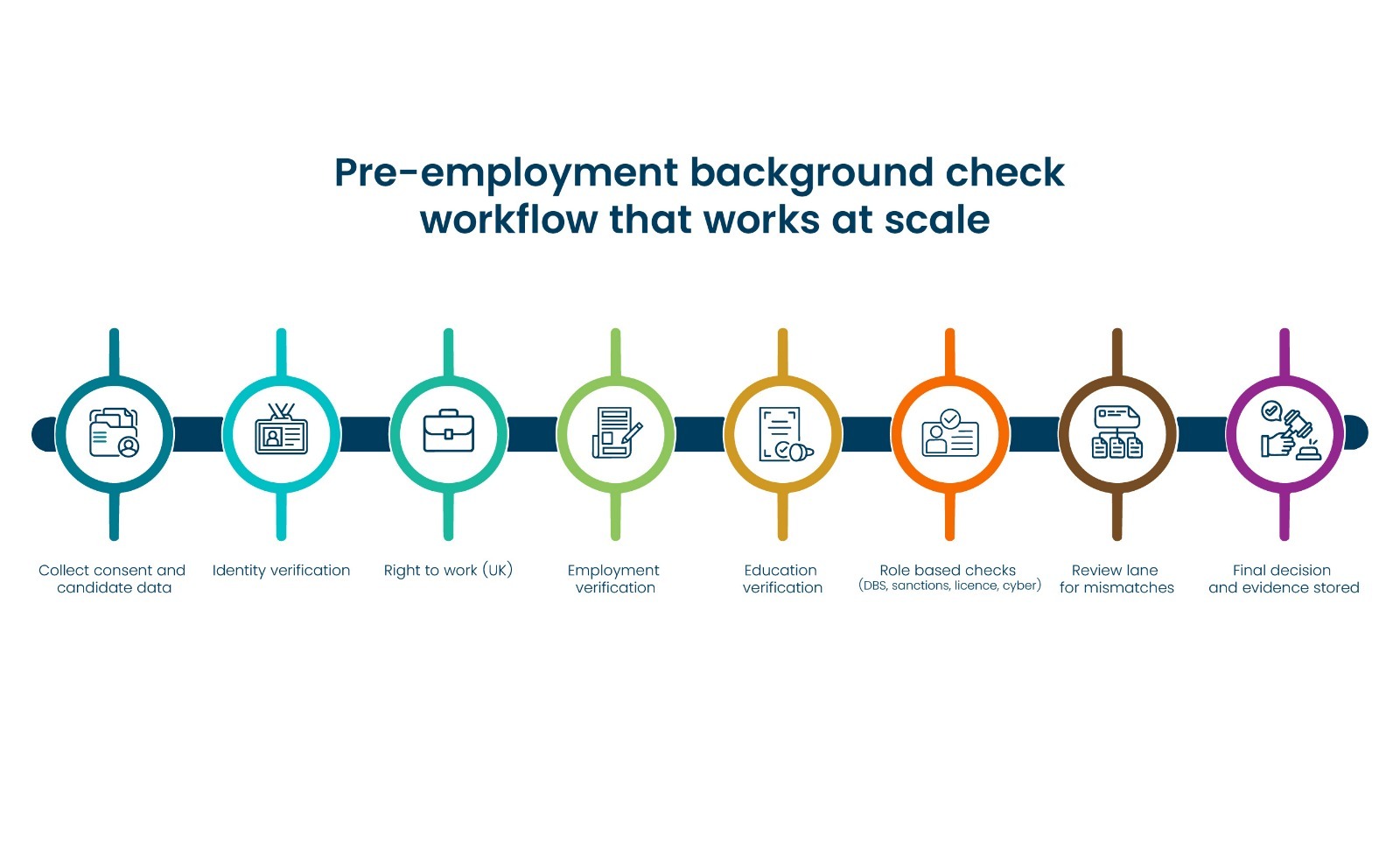
A pre-employment background check should be consistent. It should run the same way for every candidate in the same job type. It should also create a clear record of what was checked and why decisions were made.
Pre-employment background check workflow that works at scale
- Collect candidate data and written consent
- Complete identity verification
- Complete right-to-work verification for UK hires, as required
- Verify employment history through employment verification
- Verify education and qualifications
- Run job-specific checks when needed, such as DBS checks, sanctions screening, licence checks, credit checks where lawful, and cyber checks
- Send mismatches to a review lane for clarification and decision
- Make the final decision and store the evidence and decision notes
Common causes of delay
Delays usually come from incomplete address history, name mismatches across documents, incorrect employer details, missing dates, or slow replies to clarification questions. Strong data capture at the start prevents many delays.
One framework for smart, fast, and advanced screening
HR teams get better results when checks match the role. A smart background check uses simple packages for each job type and keeps clear evidence. A fast background check happens when you collect complete details early, run checks in the right order, and avoid extra back and forth. For higher risk roles, an advanced background check adds deeper checks only when needed. For roles with high system access, a cyber background check adds targeted digital risk checks without expanding beyond what the job requires.
If you hire in the UK, candidates may ask what a level 2 background check is. Map that request to the correct DBS level based on duties and eligibility. The right background check software helps HR track each step, store evidence, and manage reviews and disputes within a single workflow.
Smart background check: risk-based screening in practice
A smart background check is a risk-based process that is easy to audit. It avoids unnecessary checks and focuses effort where the job risk is real. In practice, this means packages by job family. It also means one clean data and consent step, one workflow to track progress, and a clear review path for discrepancies. Evidence matters as much as status. If you cannot show what was verified and how, the report is hard to defend. DE RISC Group helps employers set packages and produce evidence-led reports that HR teams can review quickly.
Advanced background check: when deeper screening is needed
An advanced background check is a deeper screening for high-risk roles. It is not needed for every hire. It is most common for senior leaders, finance roles with payment control, compliance, and regulated roles, and positions with sensitive customer data or cross-border authority.
In practical terms, advanced screening means adding job-specific checks and applying stricter review and documentation. Use deeper screening only when the job risk supports it. This helps control cost and turnaround time.
Cyber background check: when digital risk checks make sense
A cyber background check adds digital risk checks for roles with high access. It is most relevant for system admins, security roles, finance roles with payment access, and contractors who receive credentials. These checks should not replace identity, employment verification, or education verification. They add another layer for access risk. Keep the scope job relevant and focused on access and control.
UK background checks: DBS levels and what level 2 means
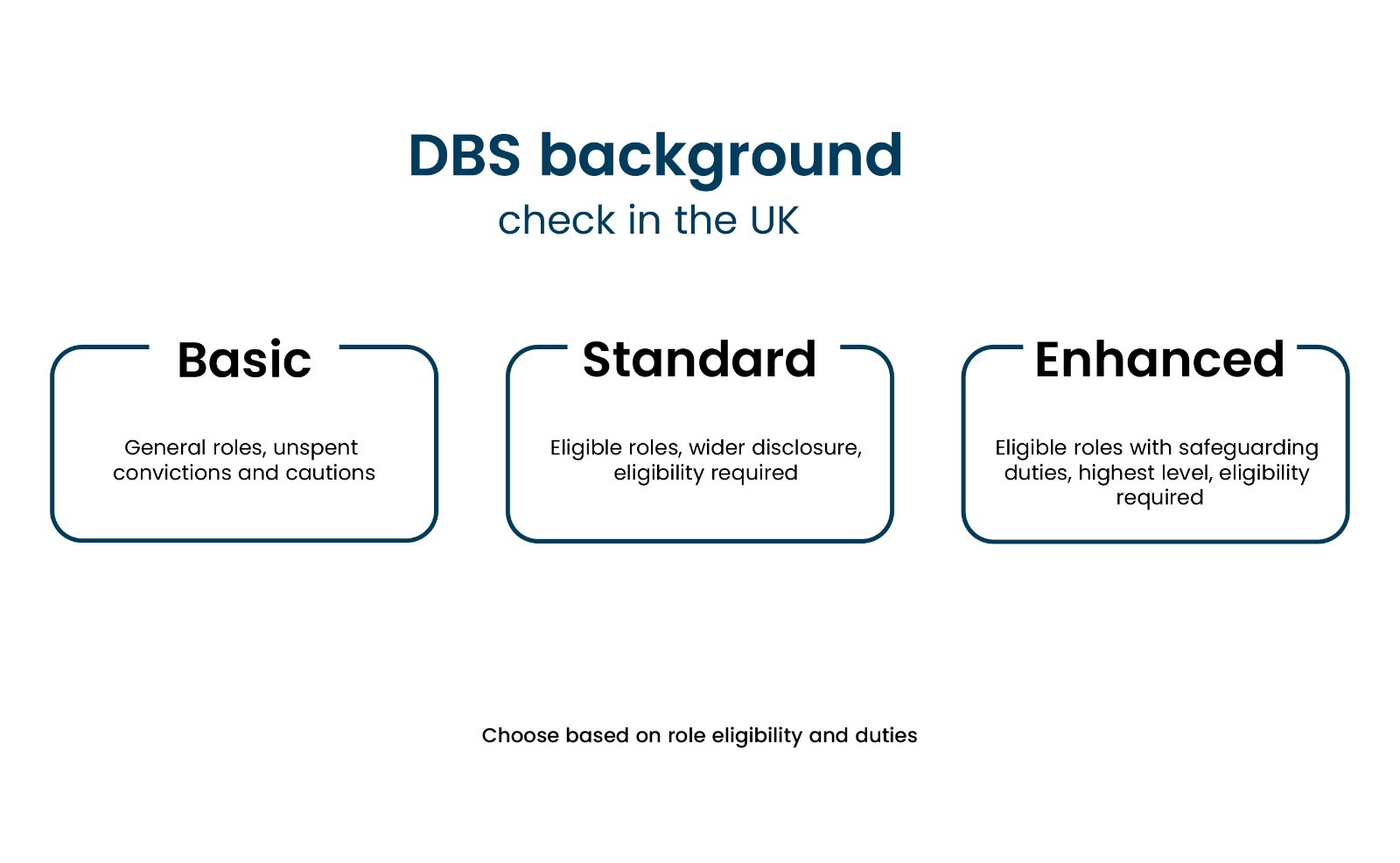
A DBS check is required for eligible roles in the UK. Employers commonly use Basic, Standard, or Enhanced DBS checks. The level you can request depends on duties and eligibility.
|
DBS level |
Typical use |
What it shows |
|
Basic DBS |
General roles where a basic criminal record check is needed |
Unspent convictions and cautions |
|
Standard DBS |
Eligible roles needing wider disclosure |
Spent and unspent convictions, subject to eligibility rules |
|
Enhanced DBS |
Eligible roles, often linked to safeguarding duties |
Wider disclosure, subject to eligibility rules and role duties |
Many HR teams hear the term level 2 background check. Level 2 is not an official DBS label. In practice, it often refers to Standard DBS or Enhanced DBS. The correct choice depends on the role duties and eligibility.
International background checks: what changes by country
The workflow can stay consistent across countries. Start with identity. Confirm employment and education. Add extra checks only when needed and lawful. Verification is completed differently by country. Data sources differ. Response times differ. Right-to-work rules differ. Criminal record checks vary in availability and eligibility.
Some markets rely more on documents and direct outreach. Others rely more on centralised systems. A strong global approach is to standardise packages by job family and use local methods inside the same workflow. Keep outcomes consistent. Store evidence for key decisions.
How do companies do background checks in India?
Most employers collect written consent, then verify identity and address. They confirm employment history and education with employers and institutions. Extra checks may be added when lawful and job-relevant. Turnaround time often depends on how complete the candidate's information is.
Fast background check: how to reduce turnaround time without losing accuracy
Fast background checks come from better processes, not fewer checks. Speed improves when packages are standardised by job type and candidate data is complete from the start. Turnaround time also improves when checks follow the right sequence, beginning with identity.
Some checks can run in parallel once identity is confirmed. Reviews move faster when discrepancies follow a clear review process and consistent decision rules. This is how teams deliver fast background checks without sacrificing accuracy.
Background check software: what it should do and what to ask vendors
Background check software should reduce manual work and improve control. It should clearly capture candidate data and consent, track progress in one place, store evidence, and maintain an audit trail.
For global hiring, software should support multiple countries without forcing process changes. It should integrate with ATS and HR systems and support a structured way to manage discrepancies and candidate disputes. Access controls should be clear and enforced.
Questions to ask vendors:
- What checks are included, and what is excluded?
- How do you define verified, unverifiable, and discrepancy?
- What evidence do you provide for employment verification and education verification?
- How do you handle disputes and rechecks?
- What are typical turnaround times by country and check type?
- How do you support right-to-work checks and record keeping where required?
- How do you support DBS eligibility and correct level selection in the UK?
- What security controls and access permissions do you provide?
- What integrations do you support?
- What is your quality control and escalation process?
Background check companies: how to choose a provider
Choosing a provider is not only about price. A low-cost check can yield unverifiable results, pushing work back onto HR. A strong provider should offer clear definitions for outcomes, evidence behind the status, predictable turnaround expectations, and a clear dispute process. They should also support secure handling of candidate data and provide a usable audit trail.
DE RISC Group supports employers hiring in the UK, India, and across global roles with packaged background verification and end-to-end background screening services.
FAQs
What is a pre-employment background check?
A pre-employment background check is the process employers use to verify a candidate's criminal record, employment history, education, and other details before finalizing a hire.
Why is identity verification the first step?
It anchors every other check. Without a confirmed identity, later checks may be run on the wrong person.
What is a level 2 background check in the UK?
It is informal wording. It often refers to Standard DBS or Enhanced DBS, depending on the role and eligibility.
What is a DBS check?
It is a UK criminal record check for eligible roles. Employers use Basic, Standard, or Enhanced levels based on duties and eligibility.
Can I get a free background check in the UK?
Not really. You can find some public information for free, but an official DBS check and compliant employment checks usually require a paid provider or application fee.
How do companies conduct background checks differently in India?
They often rely more on document-based verification and local address checks. Delays are usually due to incomplete candidate data.