Education Verification: How Employers Can Detect Fake Degrees and Credentials
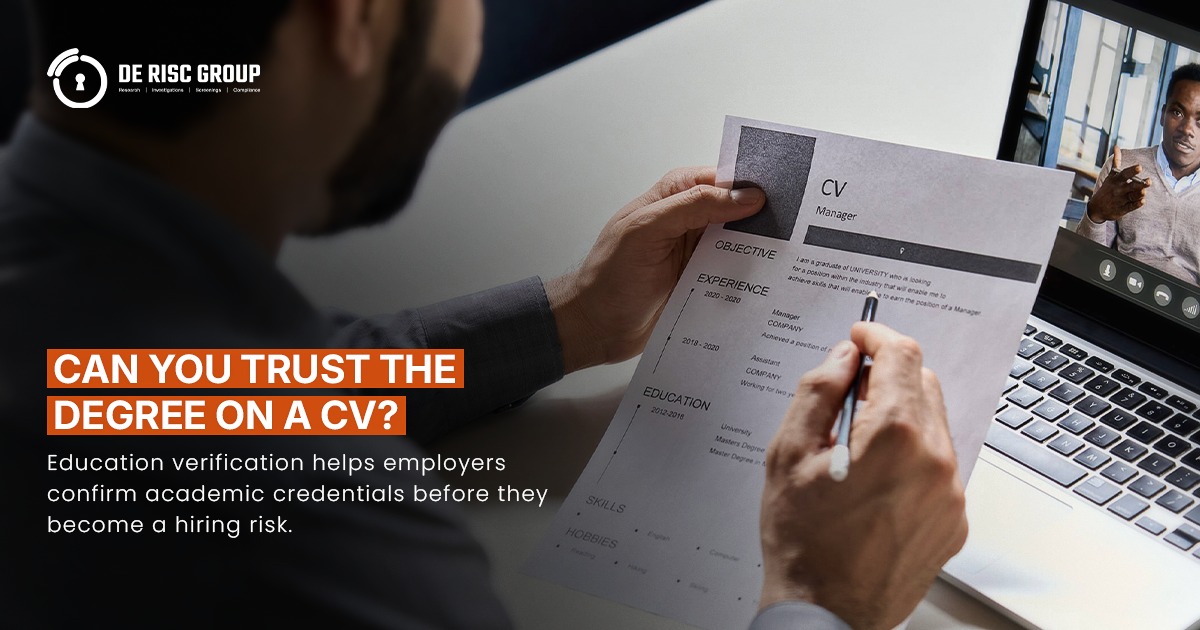
A degree on a resume looks like a settled fact. A university name, a field of study, a graduation date on paper, that's everything an employer needs to know. But in a hiring environment where candidates compete across borders and qualifications arrive in dozens of different formats, taking an academic credential at face value can leave an organization exposed to risk it never saw coming.
Education verification exists to close that gap. It checks a candidate's academic claims against the institution, official record, or authorized source behind them confirming whether they actually attended, actually completed the program, and actually received the qualification listed on the CV.
This matters because education can shape more than a hiring decision. In some industries, it determines whether someone is legally or safely able to perform the role at all. A candidate who exaggerates a qualification isn't just polishing a resume they may be presenting themselves as equipped for responsibilities they aren't authorized to carry. So, the real question for employers was never whether a candidate can produce a diploma. It's whether that diploma can be independently confirmed.
Contents
- What is education verification?.
- Why education verification matters in hiring.
- What does an education verification check confirm?.
- How employers verify degrees and academic credentials?
- Common types of education and credential fraud.
- Warning signs that may indicate a problem with a credential
- Why looking at a diploma isn't enough.
- Challenges in verifying international qualifications.
- How digital credentials are changing education verification.
- Education verification for regulated and specialized roles.
- Common mistakes employers make during education verification.
- Best practices for building an effective process.
- Privacy and compliance considerations.
- How DE RISC Group can help.
- Conclusion.
- Frequently asked questions.
What is education verification?
Education verification is the process of confirming a candidate's academic history through a reliable, independent source rather than through the candidate alone. Depending on the role and the screening requirements behind it, that can mean verifying the institution attended, the degree or diploma awarded, the field of study, dates of attendance, and graduation date.
The purpose is straightforward: establish whether what the candidate says matches what the institution's own records show. That distinction matters, because a candidate-provided document isn't independent evidence of anything. A diploma can look entirely authentic and still contain inaccurate information, and a resume can name a legitimate, well-known university while quietly overstating the qualification actually earned.
Education verification therefore focuses on the record behind the credential, not the document sitting in front of the recruiter. And the scope of that check should flex with the role confirming a completed bachelor's degree is enough for some positions, while others require confirmation of a specific specialization, a postgraduate qualification, or a professional credential tied directly to the job.
Why education verification matters in hiring
Education is often the first filter employers apply. A job description requires a specific degree, a specific field of study, or a professional qualification and if that requirement is never actually checked, it isn't really a requirement at all.
The risk shows up in a handful of familiar patterns: a candidate who attended a university but never graduated, one who holds an undergraduate degree but lists a master's, or one whose credential comes from an institution that doesn't meet the recognition standards the role requires. None of this is visible if an employer is working from a resume, an interview, and a scanned certificate those are exactly the sources a discrepancy is designed to survive.
Education verification introduces the one thing those sources can't provide: an independent reference point. Instead of assuming a qualification is genuine because it looks plausible, the employer can confirm whether the claim actually holds up. That matters most in roles where a qualification connects directly to professional competence, regulatory compliance, public safety, or customer trust and the goal isn't to treat every candidate as a potential fraud, it's to apply one consistent standard where the important claims get checked rather than assumed.
What does an education verification check confirm?
What gets verified depends on the employer's requirements, the country involved, and what records the institution is willing and able to share. In most cases, a check confirms whether the candidate attended the institution named, whether that institution awarded the qualification claimed, and the field of study, attendance dates, and graduation date behind it.
Take a candidate who states they completed a Bachelor of Science in Computer Science between 2018 and 2022. Verification tests that specific claim against the institution's own records and what it uncovers isn't always fraud. Maybe they attended from 2018 to 2021 but never graduated. Maybe the program was different from the one listed. Maybe the graduation year is simply wrong. None of these should be treated automatically as deliberate misrepresentation, they are exactly why verification needs context and, where necessary, a follow-up conversation rather than an instant conclusion. For the employer, the value isn't a pass/fail stamp. It's knowing precisely what's been confirmed and what still needs resolving.
How employers verify degrees and academic credentials?
The most reliable process is built around authoritative sources, not documents supplied by the candidate. It starts with collecting enough information to identify the right academic record full name, any previous names, institution, qualification, field of study, and dates along with candidate authorization where local law or institutional policy requires it.
From there, verification runs through an appropriate source, most often the institution itself. Universities and colleges typically have registrars, verification offices, or online portals built for exactly this purpose, and the U.S. Federal Trade Commission notes that employers can contact schools directly, with registrars able to confirm dates of attendance, degrees awarded, and majors.
Some countries also run dedicated verification infrastructure that removes much of the manual back-and-forth. In Pakistan, for instance, the Higher Education Commission operates a Degree Attestation System that scrutinizes and verifies academic documents directly with the issuing institution.
Once a result comes back, it has to be read carefully. A successful match confirms the claim. But an inability to verify doesn't automatically mean the credential is false it might simply reflect a restrictive disclosure policy, outdated records, or a slower process on the institution's end. A properly built screening programme treats "verified," "unresolved," and "discrepancy" as three different outcomes, not one.
Common types of education and credential fraud
Academic fraud rarely means a completely invented degree that's the most obvious version, but far from the only one. A candidate may have attended university without finishing, then list themselves as a graduate. Someone with a bachelor's degree might claim a master. Someone else might name a real institution but misstate the field of study or graduation date.
Then there is outright document manipulation a certificate or transcript altered to make a qualification look stronger than it is. And there are diploma mills: organizations that issue academic-looking credentials without offering anything resembling the education the credential implies. The FTC specifically flags diploma mills as a source of bogus academic credentials and recommends researching an institution's accreditation directly rather than relying on the applicant's word for it.
There's also a distinction worth holding onto: a qualification can be entirely genuine and still not be the right qualification for the role. The institution exists, the programme was real, but it doesn't meet the professional or regulatory bar the position requires. Which is exactly why education verification needs to establish not just that a credential exists, but what it actually represents.
Warning signs that may indicate a problem with a credential
A handful of patterns tend to warrant a closer look:
- An advanced degree appearing without the prerequisite qualification behind it
- An institution that's difficult to verify or has thin, inconsistent public information
- An institution name that seems deliberately close to a better-known university
- Education dates that conflict with other information elsewhere in the application
- A study period noticeably shorter than the claimed qualification would normally take
None of these prove fraud on their own. Online programmes, accelerated courses, international qualifications, transfers, and different national education systems can all produce a legitimate history that looks unusual through the lens of a single country's expectations. The point of a red flag isn't to deliver a verdict it's to trigger the verification step that actually settles the question.
Why looking at a diploma isn't enough.
A diploma is useful supporting documentation. It is not independent proof of anything, and that distinction only gets sharper as more documents arrive as PDFs and scanned images that are genuinely difficult to authenticate through visual inspection alone.
There's a real difference between asking "does this diploma look legitimate?" and asking "can the qualification be independently confirmed by the institution or another authoritative source?" Only the second question gives a hiring decision anything solid to stand on. A document can carry accurate names, dates, logos, and signatures and still fail to prove the underlying qualification was ever awarded which is exactly why the verification process should focus on the source behind the credential, not the artifact sitting in the candidate's file.
Challenges in verifying international qualifications
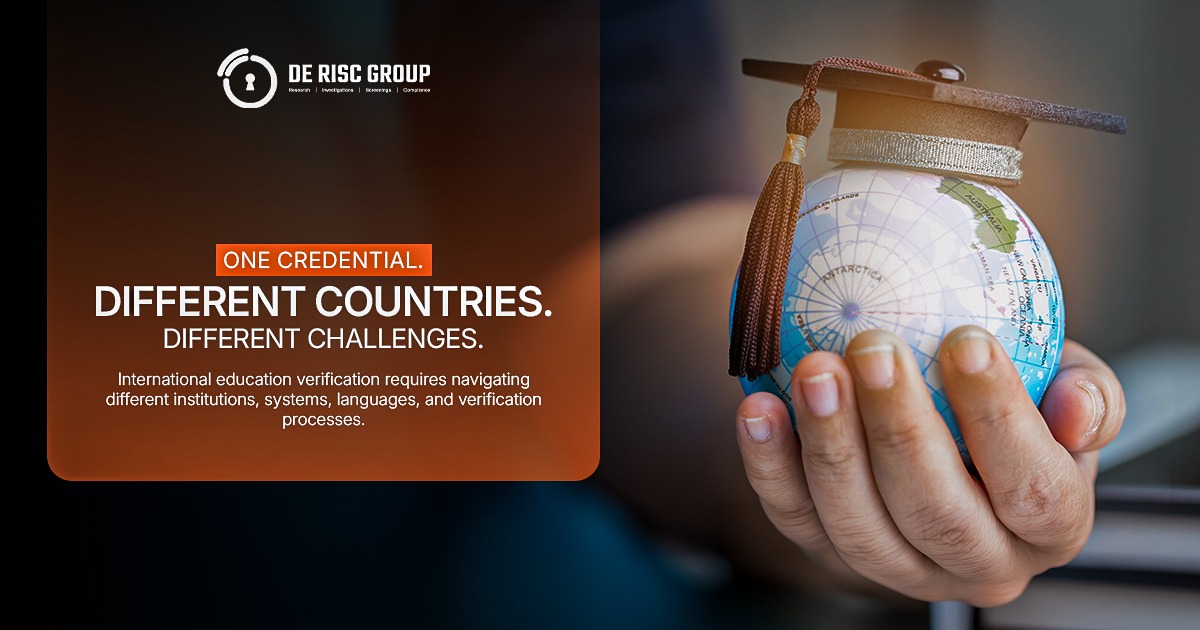
International hiring is where education verification gets genuinely complicated. A check that's simple in one country can require an entirely different process in other universities vary in terminology, academic calendars, grading systems, documentation formats, and record-keeping practice, and even a candidate's name can shift across documents due to transliteration, name order, or marriage.
Institutions also differ in how willing they are to disclose academic information. Some respond directly to employers or screening providers. Others require candidate authorization or route everything through a dedicated verification platform. And some institutions have merged, renamed, relocated, or simply stopped operating, which means identifying the right source to verify against becomes its own research task before the actual check can begin.
International education verification, in other words, isn't a global version of a domestic check it has to account for the education system, verification infrastructure, and legal requirements specific to each country. For organizations hiring across multiple markets, working with a provider that already understands those differences remove most of the administrative weight without sacrificing consistency.
How digital credentials are changing education verification
Technology is reshaping how academic qualifications get issued, stored, and confirmed. Traditional verification has leaned heavily on emails, phone calls, and manual correspondence with institutions slow by design. Digital credential systems are starting to change that, allowing academic achievements to be issued and verified electronically, which can make it easier to confirm information came directly from the issuing institution and can meaningfully speed up the workflow.
Research into blockchain-based academic credentials has explored how digital systems could make records both easier to verify and harder to tamper with. But technology doesn't remove the need for a reliable source behind the credential a digital document is only as trustworthy as the institution and system that issued it. The direction of travel is a combination: digital credentials, automated workflows, authoritative institutional data, and human review for anything that doesn't line up cleanly.
Education verification for regulated and specialized roles
How much weight education verification carries depends heavily on the role. For some positions, a degree is a preferred qualification, not a strict requirement. For others, a specific academic or professional credential is essential to doing the job at all.
Healthcare is an obvious example, where qualifications connect directly to patient safety and professional eligibility. Engineering, education, accounting, legal services, financial services, and scientific research carry similar weight. In these cases, employers typically need to establish more than "did this person attend university”, they need to confirm the specific qualification the role requires and whether any associated professional license or credential is still valid.
Education verification works best as one part of a broader screening strategy paired, depending on the role, with identity verification, employment verification, professional qualification checks, and criminal record checks, so the full candidate profile actually supports what the role demands.
Common mistakes employers make during education verification
The most common mistake is treating a candidate-supplied document as the final word, when independent verification is what actually builds confidence. A close second is assuming every institution follows the same process international institutions vary widely, and ignoring that produces delays or, worse, misleading conclusions.
Employers also tend to treat an unresolved verification as proof of fraud, when there's often a mundane reason an institution can't confirm a record immediately. And inconsistency undermines the whole exercise: if some candidates get a full education verification while others get a document glance, the process becomes hard to defend and starts to raise fairness questions of its own. Finally, it's easy to over-focus on catching fraud and lose sight of relevance not every academic detail needs investigating, only the ones the role genuinely depends on.
Best practices for building an effective process
An effective programme starts with a clear answer to one question: what does this organization actually need to verify, and for which roles? A position requiring a specific degree should have a verification process built to confirm exactly that qualification; a role where education isn't material shouldn't get the same level of scrutiny.
From there, build consistent procedures for collecting candidate information, securing authorization where required, contacting verification sources, recording outcomes, and resolving discrepancies. Prioritize institutions, official verification platforms, and other authoritative sources over websites or databases that can't be independently validated. Treat "verified," "discrepancy," and "unable to verify" as three distinct outcomes requiring three distinct responses, and keep human review in the loop for anything that doesn't resolve cleanly a mismatched graduation date is often an administrative error, not misrepresentation, and an unfamiliar institution is often legitimate, just unfamiliar. Document everything: what was checked, which source was used, what came back, and how any discrepancy was resolved. That record is what makes the process consistent and defensible over time.
Privacy and compliance considerations
Education verification handles personal information, and the rules governing it differ by country sometimes by jurisdiction within the same country. Depending on where a candidate is based, employers may need to address consent, data protection, disclosure requirements, retention periods, and cross-border data transfer.
A responsible process collects only what's relevant to the screening purpose and protects it for as long as it's held. Transparency matters just as much as the mechanics candidates should understand what's being verified and why. And a potential discrepancy should never lead straight to an adverse decision without proper review and, where applicable, a chance for the candidate to explain or correct the record. The balance employers are managing is genuinely two-sided: protecting the organization from credential fraud while respecting the rights and privacy of the people being screened.
How DE RISC Group can help
For organizations hiring across multiple countries and education systems, running education verification internally gets difficult to manage at scale fast different institutions, different languages, different verification infrastructure, all landing on the same recruiter's desk.
DE RISC Group runs education verification as part of a broader global screening programme, combined where relevant with identity verification, employment verification, criminal record checks, address verification, sanctions and watchlist screening, and professional qualification checks. That means the screening scope can be built around what a specific role actually requires, rather than running every candidate through an identical checklist regardless of risk.
For employers hiring internationally, that cross-jurisdiction experience is where most of the value sits it's the difference between chasing down an unfamiliar institution's verification process yourself and having a partner who already knows how. If your team is expanding into new education systems and needs a verification process that can keep pace, start with Employee RISC Assessment.
Effective screening was never about assuming candidates are dishonest. It's about building a reliable process for confirming the claims that matter before those claims become the basis of a hiring decision.
Conclusion
A qualification on a resume is a claim. Education verification is what turns that claim into evidence.
In an increasingly global hiring market, employers can't rely on the look of a certificate, the name of a university, or how confidently a candidate talks about their degree in an interview. Credentials get exaggerated, misunderstood, altered, and occasionally fabricated outright and the stakes rise sharply whenever a specific qualification is essential to the role itself.
Effective education verification looks past the document. It examines the record behind it, works through the appropriate source, accounts for the relevant education system, and investigates discrepancies before drawing conclusions. The strongest programmes are also proportionate they focus on the qualifications that actually matter to the role, apply the same standard to every candidate, respect privacy throughout, and treat a discrepancy as something to review rather than something to punish on sight.
For employers, that adds up to more than a stronger hiring process. It protects professional standards and puts every hiring decision on ground that's actually been checked. A degree can be listed on a resume. The real question is whether it can be independently verified.
Frequently asked questions
Q: What is education verification?
The process of confirming a candidate's claimed academic qualifications through the institution, an official database, a digital credential system, or another appropriate independent source.
Q: Can a fake degree be detected during a background check?
Yes. Education verification can catch discrepancies between what a candidate claims and what the institution's records show, and it can flag qualifications that can't be independently confirmed. An inability to verify isn't automatic proof of fraud, though it usually calls for further investigation.
Q: Is a diploma enough to verify a degree?
No. A diploma is candidate-provided documentation. Independent confirmation from the institution or another authoritative source is what actually establishes that the qualification was awarded.
Q: Why is international education verification more difficult?
Different education systems, languages, degree structures, record-keeping practices, and privacy rules make it hard to apply one standardized process across every country.
Q: What happens if an employer can't verify a qualification?
The employer should establish why before drawing any conclusion. Limited disclosure policies, unavailable records, or processing delays are common explanations, and further documentation or candidate clarification may resolve it.
Q: Why should employers use education verification?
It confirms academic claims, surfaces discrepancies, reduces the risk of credential fraud, and gives employers a more informed basis for hiring decisions particularly where a specific qualification matters to the role.
Related services
If you want screening built around your actual hiring risk, start with Employee RISC Assessment. If your exposure sits with vendors and contractors, use Supply Chain RISC Assessment. If you're expanding into new markets, start with Market RISC Assessment.