Workplace Drug Testing: What Employers Should Consider Before Implementing a Programme
Workplace Drug Testing: What Employers Should Consider Before Implementing a Programme
Maintaining a safe, productive, and responsible workplace requires employers to consider a range of factors that can affect employee well-being and organizational performance. Among these is the potential impact of drug and alcohol use on workplace safety, particularly in roles involving machinery, transportation, hazardous environments, or other safety-sensitive responsibilities.
Workplace drug testing can form part of an organization's broader approach to managing these risks. When implemented appropriately, it can help employers establish whether certain workplace standards are being met and support informed decisions about occupational safety. However, introducing a testing programme involves more than selecting a testing method or requiring employers to provide samples. Organizations must also consider the purpose of testing, the nature of the roles involved, the reliability of results, employee privacy, and applicable legal requirements.
A poorly designed programme may create unnecessary concerns, undermine employee trust, or produce results that are difficult to interpret. By contrast, a clearly defined and proportionate approach can help organizations address legitimate safety concerns while respecting employee rights.
Understanding these considerations is an important first step for any employer planning to introduce or review a workplace drug testing programme.
Contents
- What Is Workplace Drug Testing?
- Why Do Employers Consider Workplace Drug Testing?
- Types of Workplace Drug Testing Programmes
- Developing a Clear Workplace Drug Testing Policy
- Understanding Test Accuracy and Positive Results
- What Should Employers Do When a Test Result Is Positive?
- Common Mistakes Employers Should Avoid
- How Background Screening Providers Can Support Drug Testing Programmes
- Building a Responsible Workplace Drug Testing Programme
- Final Thoughts
- Frequently Asked Questions (FAQs)
What Is Workplace Drug Testing?
Workplace drug testing refers to the process of testing employees or prospective employees for the presence of specified substances, in accordance with an organization's policy and applicable legal requirements. It may be used as part of an occupational health and safety programme, a recruitment process, or a broader workplace risk management strategy.
The purpose of testing should be clearly established before a programme is introduced. For example, an employer operating a fleet of commercial vehicles may have legitimate safety concerns about employees performing safety-critical duties while impaired. An organization employing personnel in a regulated or high-risk environment may also have specific obligations that influence its testing requirements.
However, workplace drug testing should not automatically be treated as a standard requirement for every employee. Its necessity and scope depend on the nature of the work, the risks involved, and the laws governing the employment relationship.
The UK Health and Safety Executive advise employers to consider carefully what workplace screening is intended to achieve and how the resulting information will be used. It also emphasizes that testing should form part of a broader health and safety approach rather than being treated as a complete solution to workplace substance-related concerns.
Why Do Employers Consider Workplace Drug Testing?
Organizations may consider workplace drug testing for several reasons, although the justification will vary by industry, role, and jurisdiction.
Promoting Workplace Safety
In safety-sensitive environments, impaired judgment, coordination, or reaction time can create risks for employees, colleagues, customers, and the public. This is particularly relevant to certain transportation, construction, industrial, and machinery-operating roles.
Testing may be one measure within a wider safety programme designed to reduce these risks. Nevertheless, a test result does not automatically establish whether an individual is currently impaired. Employers should understand the capabilities and limitations of the testing method selected and avoid treating a result as conclusive evidence of an employee's fitness for duty without appropriate interpretation.
Supporting Workplace Policies
Some organizations establish drug and alcohol policies that define expectations regarding fitness for duty, prohibited conduct, and the circumstances in which testing may take place.
A clearly communicated policy helps employees understand the organization's standards and the procedures that may apply if concerns arise. It also provides managers with a consistent framework for responding to relevant situations rather than making decisions without established criteria.
Meeting Applicable Requirements
Depending on the jurisdiction and industry, particular roles may be subject to legal, regulatory, contractual, or sector-specific testing requirements. Employers should identify which obligations apply to their operations before implementing a programme.
The requirements are not universal. A practice permitted in one jurisdiction may be restricted in another, and employers should obtain appropriate legal guidance where the position is unclear.
Common Workplace Drug Testing Methods
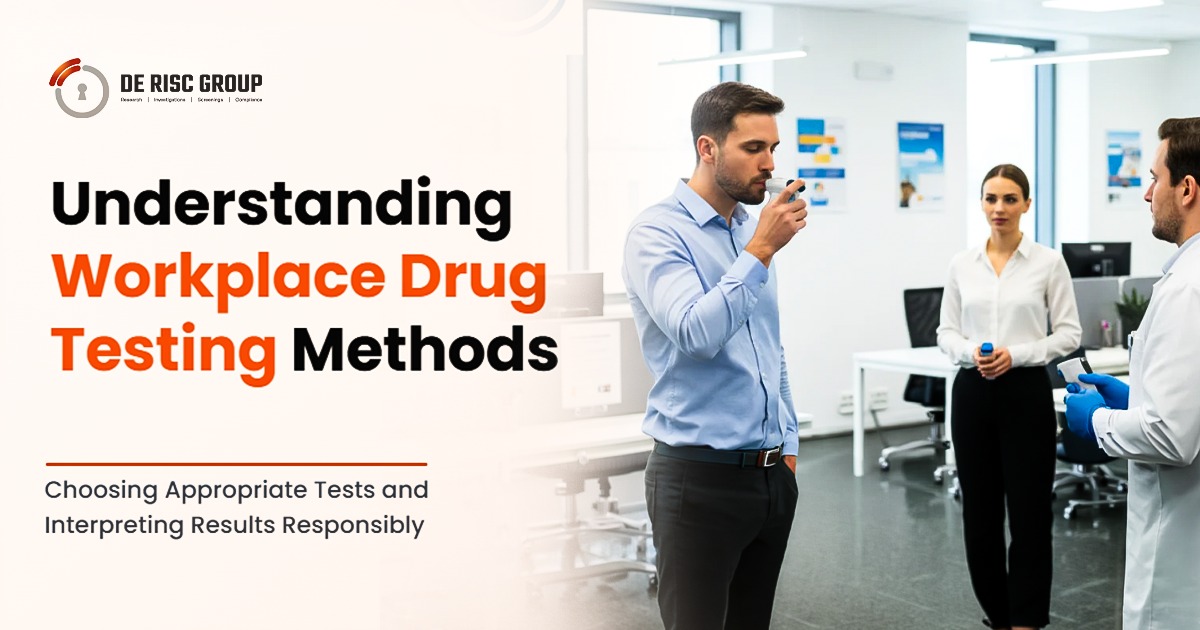
The appropriate testing method depends on the substances being assessed, the purpose of testing, the applicable requirements, and the circumstances in which the test will be conducted. Different methods can provide different types of information and have different limitations.
Urine Drug Testing
Urine testing is used in workplace screening programmes to identify specified substances or their metabolites. Depending on the substance and other factors, a urine test may detect exposure over a period that extends beyond the time when the substance was consumed.
This distinction is important. A positive urine result does not, by itself, establish that an employee was impaired while performing work duties. Employers should understand the detection window and interpretation limitations associated with the selected test.
Saliva Drug Testing
Saliva testing involves collecting an oral fluid sample for analysis. Depending on the substance and testing method, it may be useful when the objective is to assess relatively recent substance exposure.
However, detection windows vary, and a saliva result should not automatically be treated as a direct measurement of impairment. Employers should select this method based on their defined objectives and the capabilities of the testing process.
Other Testing Methods
Other approaches may include blood testing or specialized testing methods used in particular occupational or regulatory contexts. Breath testing is commonly associated with alcohol testing rather than the detection of every drug covered by a workplace programme.
Each method has different practical, scientific, and privacy considerations. Employers should work with qualified testing providers to understand which approach is suitable for their needs and what conclusions can reasonably be drawn from the results.
Types of Workplace Drug Testing Programmes
Workplace drug testing can take place in different circumstances. The programme selected should reflect the organization's objectives, the risks associated with particular roles, and applicable law.
Pre-Employment Drug Testing
Some employers include drug testing during recruitment for positions where it is relevant and legally permissible. The timing and requirements should be communicated to candidates in advance, including any conditions attached to a potential appointment.
Pre-employment testing should be justified by the requirements of the role rather than applied indiscriminately. Employers should also ensure that the process is consistent with relevant employment, privacy, and anti-discrimination requirements.
Random Drug Testing
Random testing involves selecting employees for testing according to a genuinely random process within a defined and justified testing group.
Although some organizations use random testing as part of their safety programmes, it is not automatically appropriate for every workplace or employee. Employers should consider whether the risks associated with the roles being tested justify this approach and whether less intrusive measures could achieve the same objective.
The selection criteria and procedures should be documented and communicated clearly. Where random testing is used, the process should be genuinely random rather than presented as random when employees are actually selected according to undisclosed criteria.
Reasonable-Suspicion or For-Cause Testing
In some workplaces, testing may be considered when specific, documented observations or circumstances create a reasonable concern that an employee may be impaired while performing their duties.
Organizations should define the circumstances that may trigger such testing and train relevant managers to follow established procedures. Decisions should be based on objective, role-relevant observations rather than assumptions, personal disagreements, or discriminatory treatment.
Employers should also consider whether an immediate fitness-for-duty assessment or another safety measure is necessary while the concern is addressed.
Post-Incident Testing
Testing may be considered following a workplace incident where there is a legitimate basis to investigate possible substance-related impairment. The circumstances in which post-incident testing is appropriate should be defined in the policy and must comply with applicable requirements.
Not every accident or workplace incident automatically justifies drug testing. Employers should assess the facts, the nature of the incident, and the relevance of testing to the investigation.
Periodic or Ongoing Testing
Some organizations may require periodic testing for particular roles, subject to the relevant legal and operational requirements. The frequency and scope should be based on a documented assessment of risk rather than an assumption that repeated testing is necessary for every employee.
Employers should regularly review whether their programme remains appropriate and whether its objectives could be achieved through less intrusive measures.
Developing a Clear Workplace Drug Testing Policy
A written policy provides the foundation for a consistent and transparent testing programme. It should explain why testing is conducted, who may be tested, how the process works, and what happens when a result requires further review.
First, employers should identify the specific purpose of testing. A programme designed to address safety-sensitive duties may require a different approach from one intended to meet a defined regulatory obligation. Clearly establishing the purpose helps determine the appropriate testing method and scope.
The policy should then specify the circumstances in which testing may take place. These may include pre-employment testing, testing for defined safety-sensitive positions, reasonable-suspicion situations, or post-incident circumstances, where appropriate and legally permissible.
It should also explain which substances are included in the testing panel, how employees will be informed, what procedures will be followed during sample collection, and how results will be communicated.
Another important consideration is the treatment of disputed or unexpected results. Employees should understand the process for requesting clarification, providing relevant information, or seeking review where appropriate. Employers should establish a clear procedure for handling initial positive results and determining whether confirmatory testing or independent professional review is necessary.
Finally, the policy should explain the possible consequences of a result or refusal to participate, subject to applicable law and employment arrangements. Communicating these expectations in advance can help reduce uncertainty and support fair, consistent decision-making.
Consent, Privacy, and Employee Rights
Drug testing can involve the collection of sensitive personal information. Employers must therefore consider not only whether testing is useful, but also whether it is necessary, proportionate, and legally permissible.
Consent requirements vary by jurisdiction and employment context. Employers should not assume that including a testing clause in a contract automatically satisfies every applicable legal requirement. They should establish the appropriate legal basis, authorization, or consent process before collecting samples or processing results.
Transparency is equally important. Employees should be informed about when testing may occur, what substances are being tested for, why the information is being collected, how results will be used, and what safeguards are in place.
Privacy should be protected throughout the process. Sample collection should be handled discreetly and in accordance with established procedures. Access to results should be restricted to authorized individuals who need the information for a legitimate purpose. Records should be stored securely and retained only in accordance with applicable requirements.
Employers should also consider whether a less intrusive measure could address the same concern. Testing every employee may not be justified where the relevant safety risk is associated with only a specific group of roles.
For UK employers, the Information Commissioner's Office provides guidance on the use of medical examinations and drug and alcohol testing in employment. Its guidance emphasizes the need to establish a clear purpose, identify an appropriate legal basis for processing, explain testing arrangements to workers, and minimize unnecessary collection of personal information.
These considerations are central to maintaining a programme that protects both workplace safety and employee rights.
Understanding Test Accuracy and Positive Results
One of the most important aspects of workplace drug testing is understanding what a result actually establishes.
Screening tests may identify a potential positive result that requires further assessment. Depending on the method and circumstances, factors such as the test's limitations, sample integrity, prescribed medication, and the possibility of cross-reactivity may need to be considered.
For this reason, organizations should establish procedures for handling results that require confirmation. Where appropriate, a qualified laboratory or other suitable testing professional should conduct confirmatory analysis and support the interpretation of findings.
Employers should avoid making consequential employment decisions solely on the basis of an unconfirmed screening result when further review is warranted. They should also provide a defined process for employees to raise relevant concerns or challenge an apparent discrepancy.
Importantly, a positive test does not necessarily establish current impairment, and a negative result does not guarantee that an individual is fit for duty in every respect. Results must be interpreted in the context of the test's purpose, detection window, and limitations.
Clear reporting and appropriate professional review help organizations make more informed decisions while reducing the risk of misinterpreting the evidence.
What Should Employers Do When a Test Result Is Positive?
A positive result should be handled through a documented procedure rather than an immediate, automatic disciplinary response.
Where the testing method produces an initial screening result, the employer should follow the established process for confirmation and review. The employee should be informed in accordance with the policy, and relevant information should be assessed by appropriately qualified personnel where necessary.
Employers should then consider the circumstances, the requirements of the role, applicable law, and any relevant contractual or organizational procedures. Where the concern relates to immediate safety, temporary measures may be necessary to prevent the employee from undertaking safety-sensitive duties while the matter is assessed.
The response should be consistent with the organization's policy and should avoid assumptions that go beyond the available evidence. Depending on the circumstances, the appropriate outcome may involve further assessment, fitness-for-duty procedures, disciplinary action where justified, or access to support resources.
Organizations should also ensure that confidential information is not shared more widely than necessary.
A fair process protects the integrity of the testing programme and helps ensure that decisions are based on reliable information rather than an unreviewed result.
Common Mistakes Employers Should Avoid
Workplace drug testing can become ineffective or unnecessarily intrusive when organizations introduce it without adequate planning.
One common mistake is testing employees without establishing a clear purpose. If an employer cannot explain what risk the programme is intended to address, it may be difficult to justify the scope and frequency of testing.
Another mistake is applying identical requirements to roles with substantially different responsibilities. A policy should reflect the risks associated with the work rather than assuming that every employee presents the same level of safety concern.
Employers should also avoid treating every positive screening result as conclusive evidence of impairment or misconduct. Testing methods have limitations, and the procedures for confirmation and review should be established before the programme begins.
Inadequate communication can create further problems. Employees should not have to guess when testing may occur, what information will be collected, or how the results may affect them.
Finally, organizations should not overlook privacy, record security, and local legal requirements. A testing programme that addresses one operational concern but creates avoidable legal or privacy risks may fail to achieve its broader objectives.
Reviewing these issues before implementation can help employers create a programme that is practical, transparent, and proportionate.
How Background Screening Providers Can Support Drug Testing Programmes
Implementing workplace drug testing requires careful coordination between organizational policies, testing procedures, and the providers involved. Employers may need support in identifying suitable services, understanding the scope of available testing, and arranging procedures that meet their operational requirements.
A background screening provider can help organizations access relevant drug screening services and understand the practical considerations involved in arranging checks. This may include clarifying the available testing options, discussing location-specific requirements, and explaining the scope and limitations of the service being requested.
For organizations operating across multiple countries, these considerations can be particularly important. Testing availability, collection procedures, documentation requirements, and applicable legal restrictions may differ between jurisdictions. A programme that works in one location may need to be adapted before it can be implemented elsewhere.
At DE RISC Group, drug screening is among the services organizations can consider as part of their broader background screening requirements. The appropriate testing arrangement will depend on the client's needs, the location, the role involved, and the applicable requirements.
Organizations should establish their policy and compliance requirements first, then select testing services that align with those needs. Clear communication between the employer and screening provider helps ensure that the requested service is understood and that its scope and limitations are accurately represented.
Building a Responsible Workplace Drug Testing Programme
A workplace drug testing programme should be designed around a clearly defined purpose, appropriate procedures, and a sound understanding of the risks involved.
Employers should assess which roles genuinely require testing, determine the appropriate method, and establish transparent policies covering consent, privacy, sample collection, result interpretation, and follow-up procedures. They should also review the programme periodically to ensure it remains aligned with changing business needs and applicable legal requirements.
Testing should form part of a wider workplace safety strategy that may include employee education, manager training, clear fitness-for-duty procedures, and access to appropriate support where relevant.
The objective is not simply to introduce testing, but to ensure that it serves a legitimate purpose and produces information that can be interpreted and used responsibly.
Final Thoughts
Workplace drug testing can play a role in managing occupational risks, particularly where substance-related impairment could affect safety-sensitive duties. However, an effective programme requires more than choosing a testing method or setting a testing schedule.
Organizations must consider the purpose of testing, the relevance of the method, the reliability of results, employee privacy, and the legal requirements that apply in each jurisdiction. They must also establish clear procedures for reviewing results and making fair, evidence-based decisions.
By approaching workplace drug testing as part of a broader risk management strategy, employers can make more informed decisions about when testing is appropriate and how it should be conducted.
DE RISC Group supports organizations with background screening and drug screening services, helping them consider verification requirements in the context of their operational needs. With a clearly defined policy and an appropriate screening approach, organizations can work towards maintaining safer workplaces while respecting the rights and privacy of the people they employ.
Frequently Asked Questions (FAQs)
1. What is workplace drug testing?
Workplace drug testing is the process of testing employees or prospective employees for specified substances under an organization's policy and applicable legal requirements. It may be used for recruitment, occupational safety, or other legitimate workplace purposes.
2. What are the most common workplace drug testing methods?
Common methods include urine and saliva testing. Other methods, such as blood testing, may be used in specific circumstances. The appropriate method depends on the purpose of testing, the substances being assessed, and the applicable requirements.
3. Can employers require employees to take drug tests?
This depends on the jurisdiction, the employment arrangement, and the circumstances. Employers should establish the relevant legal requirements, communicate their policies clearly, and follow appropriate consent or authorization procedures.
4. When can workplace drug testing take place?
Depending on the policy and applicable law, testing may take place before employment, randomly within a justified testing group, following specific reasonable-suspicion circumstances, after certain workplace incidents, or periodically for particular roles.
5. Does a positive drug test mean an employee is impaired?
Not necessarily. A positive result may indicate exposure to a substance within the test's detection window, but it does not automatically establish current impairment. Results should be interpreted in light of the testing method, its limitations, and any necessary confirmation.
6. How can employers protect employee privacy during drug testing?
Employers should define a legitimate purpose, explain the testing process, limit the collection and use of personal information, restrict access to results, maintain appropriate security, and follow applicable data protection and employment laws.
7. Why is a written workplace drug testing policy important?
A written policy establishes when testing may occur, which procedures apply, how results are handled, and what consequences may follow. It supports transparency, consistency, and informed decision-making.
8. Can workplace drug testing be used for international employees?
Potentially, but employers must consider the laws and procedures applicable in each jurisdiction. Testing availability, privacy obligations, consent requirements, and permitted practices may differ between countries.
9. How can DE RISC Group support workplace drug screening?
DE RISC Group offers drug screening services as part of its broader screening capabilities. Organizations can discuss their requirements to identify available options, subject to location, service scope, and applicable legal requirements.
10. What should employers consider before introducing workplace drug testing?
Employers should assess the risks associated with the relevant roles, define the purpose and scope of testing, choose a suitable method, establish a written policy, address consent and privacy, and develop procedures for interpreting and responding to results.