Trust and Compliance: Finding the Balance in Background Screening
Trust and Compliance: Finding the Balance in Background Screening
In today's increasingly interconnected business environment, trust is one of the most valuable assets an organisation can build. Every hiring decision carries a degree of responsibility, not only towards the organisation but also towards employees, clients, business partners, and other stakeholders. As companies expand their operations and recruit talent across different markets, establishing trust requires more than reviewing qualifications and conducting interviews. It requires a reliable understanding of the individuals being brought into the organisation.
This is where background screening plays an important role. By helping employers verify information, identify potential discrepancies, and make informed recruitment decisions, background screening contributes to a more transparent and accountable hiring process. However, the importance of verification must be balanced with another equally significant responsibility: compliance.
Collecting and processing personal information involves legal, ethical, and operational obligations. Organisations must therefore ensure that their screening practices are not only thorough but also proportionate, transparent, and aligned with applicable regulations. The challenge is not simply to gather information, but to establish a process that protects organizational interests without compromising individual rights.
Contents
- Why Trust and Compliance Must Go Hand in Hand
- The Importance of Transparency and Informed Consent
- Data Protection: Safeguarding Information at Every Stage
- Navigating Different Regulations Across Global Markets
- Accuracy, Fairness, and the Responsible Use of Information
- Technology and Human Oversight in Compliant Screening
- Building a Screening Framework That Inspires Confidence
- Responsible Verification Builds Lasting Trust
Why Trust and Compliance Must Go Hand in Hand
Background screening is fundamentally built around trust. Employers need confidence that the information provided by prospective employees is accurate, while candidates expect their personal information to be handled responsibly.
When screening is conducted without appropriate safeguards, even a well-intentioned verification process can create unnecessary risks. Excessive data collection, unclear consent procedures, inconsistent verification practices, and inappropriate disclosure of personal information can undermine confidence in the recruitment process.
Compliance provides the framework that helps prevent these issues. It establishes boundaries around what information can be collected, how it should be processed, who can access it, and how long it should be retained.
More importantly, compliance should not be viewed as a separate administrative requirement. It should form part of the entire screening process, guiding decisions from the initial request for candidate information through to the final delivery and handling of verification results.
The Importance of Transparency and Informed Consent
A trustworthy screening process begins with transparency. Candidates should understand why background checks are being conducted, what categories of information may be verified, and how their information will be used.
Informed consent, where required by applicable laws and regulations, is an important part of this process. It helps establish a clear understanding between employers, screening providers, and candidates regarding the purpose and scope of verification.
However, consent alone does not make every screening activity appropriate or lawful. Organisations must also consider the relevant legal basis for processing personal information, the requirements of local regulations, and whether the checks being conducted are necessary for the position.
Clear communication can also improve the candidate experience. When individuals know what to expect, which documents may be required, and why additional information is being requested, they are better positioned to participate in the process confidently.
Transparency therefore serves two purposes: it supports compliance and strengthens the relationship between organisations and the individuals they intend to employ.
Data Protection: Safeguarding Information at Every Stage
Background screening often involves sensitive and confidential information, including employment records, educational qualifications, identity documents, criminal record information, and professional references.
The responsibility to protect this information extends beyond the point of collection. It applies throughout the entire screening lifecycle, including storage, access, processing, reporting, retention, and eventual disposal.
Organisations and screening providers should establish appropriate safeguards to minimise the risk of unauthorized access, accidental disclosure, or misuse of personal information.
These safeguards may include:
Controlled access: Restricting access to candidate information to authorized personnel with a legitimate business requirement.
- Secure information handling: Implementing appropriate technical and organizational measures to protect information during storage and transmission.
- Data minimization: Collecting only the information necessary for the defined screening purpose.
- Retention management: Establishing clear retention periods in accordance with applicable legal and regulatory requirements.
- Confidential reporting: Ensuring that verification results are shared only with authorized recipients.
A responsible approach to data protection does more than reduce operational and legal risks. It demonstrates that an organisation recognizes the importance of individual privacy and treats candidate information with the care it deserves.
Navigating Different Regulations Across Global Markets
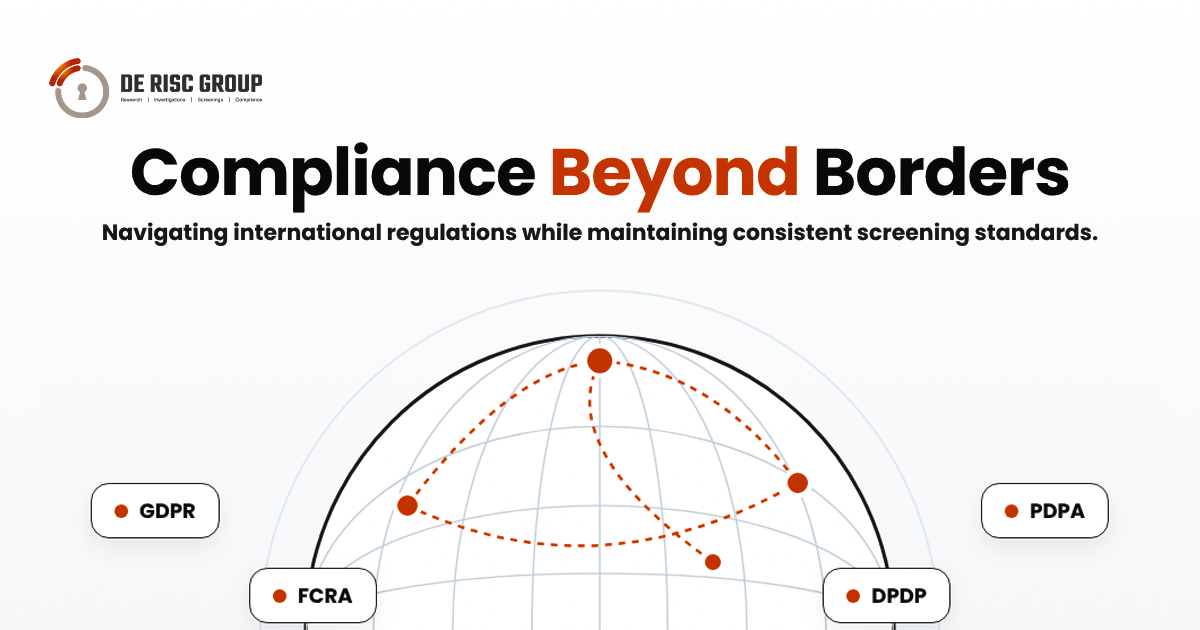 For organisations operating internationally, maintaining consistent screening standards can be particularly challenging. Background screening requirements vary considerably between countries, and practices that are permissible in one jurisdiction may be restricted or subject to additional conditions in another.
Differences may relate to criminal record checks, employment and education verification, access to public records, data protection requirements, candidate consent, and the transfer of personal information across international borders.
For example, criminal record checks may be subject to specific eligibility requirements or restrictions depending on the jurisdiction and the nature of the role. Similarly, obtaining educational or employment records may require particular authorisations or supporting documentation.
This makes local regulatory awareness an essential part of global screening operations.
Organisations should avoid applying a single screening approach indiscriminately across all markets. Instead, they should develop screening frameworks that maintain consistent quality standards while accommodating local legal requirements.
Working with experienced screening partners who understand regional verification procedures can help organisations navigate these differences more effectively. Local knowledge, reliable verification channels, and awareness of applicable restrictions all contribute to a more responsible and dependable screening process.
Accuracy, Fairness, and the Responsible Use of Information
Compliance is not limited to the lawful collection and processing of information. It also involves ensuring that the results of background screening are interpreted and used responsibly.
A discrepancy in a candidate's information does not automatically indicate dishonesty or misconduct. Differences in employment dates, variations in job titles, institutional recordkeeping practices, or incomplete documentation may have reasonable explanations.
For this reason, verification results should be assessed in their proper context rather than treated as automatic grounds for rejection.
Employers should distinguish between verified information, unresolved discrepancies, and cases where records could not be obtained. A lack of available information should not automatically be interpreted as a negative finding.
Where discrepancies arise, candidates should be given an appropriate opportunity to clarify or provide supporting documentation, in accordance with applicable laws and organisational procedures.
This approach supports fairer recruitment decisions and reduces the possibility of inaccurate assumptions influencing employment outcomes.
Ultimately, the value of background screening lies not simply in identifying inconsistencies, but in helping organisations understand the information available to them and make decisions based on reliable evidence.
Technology and Human Oversight in Compliant Screening
Technology has significantly influenced how background screening is conducted. Digital platforms, automated workflows, and integrated verification systems can improve efficiency, streamline information management, and support more consistent processes.
However, technological efficiency must be accompanied by appropriate oversight.
Automated systems may identify discrepancies or flag information requiring further review, but not every result can be understood without context. Variations in record formats, differences in naming conventions, and jurisdiction-specific documentation requirements may require additional investigation.
Human oversight remains important in reviewing complex cases, interpreting unusual findings, and ensuring that results are communicated accurately.
A balanced approach combines the operational advantages of technology with professional judgement and established quality-control procedures. This helps organisations benefit from more efficient screening without overlooking the legal, ethical, and practical considerations involved in handling personal information.
Building a Screening Framework That Inspires Confidence
Finding the balance between trust and compliance requires a structured approach. Organisations should treat background screening as an ongoing risk-management process rather than a one-time recruitment formality.
A reliable framework should begin with clearly defined screening objectives and role-specific requirements. The scope of verification should be proportionate to the responsibilities of the position, while all checks should be conducted in accordance with applicable laws.
Equally important is the selection of screening partners. Organisations should consider a provider's verification capabilities, geographical coverage, information security practices, quality-control procedures, and understanding of local regulatory environments.
Regular reviews of screening policies and procedures can also help organisations respond to changing regulations, emerging risks, and evolving business requirements.
When these elements work together, background screening becomes more than a mechanism for verifying information. It becomes part of a broader commitment to responsible recruitment, organizational integrity, and long-term trust.
Responsible Verification Builds Lasting Trust
The effectiveness of background screening should not be measured solely by how quickly checks are completed or how much information is collected. Its real value lies in the confidence it provides organisations to make informed decisions while respecting the rights and privacy of individuals.
Trust and compliance are not competing priorities. They are interconnected principles that strengthen the credibility and effectiveness of the screening process.
As recruitment becomes increasingly global and information continues to move across digital platforms and international boundaries, organisations must place greater emphasis on responsible verification practices. This means maintaining accuracy, protecting personal information, understanding local requirements, and ensuring that every screening decision is supported by appropriate evidence.
At DE RISC Group, we recognize that effective background screening is built on more than verification alone. It requires an approach that values accuracy, confidentiality, regulatory awareness, and responsible information handling.
Because building a trustworthy workforce begins with a screening process that organisations can trust.
Frequently Asked Questions (FAQs)
1. What is the role of compliance in background screening?
Compliance ensures that background checks are conducted in accordance with applicable laws and regulations, protecting both organisations and candidates throughout the verification process.
2. Why is candidate consent important in background screening?
Candidate consent, where legally required, helps ensure transparency and informs individuals about the purpose and scope of verification. Organisations must also establish an appropriate legal basis for processing personal information.
3. How is candidate information protected during background screening?
Information can be protected through secure storage, restricted access, data minimisation, confidentiality measures, and appropriate retention and disposal policies.
4. What challenges do organisations face when conducting international background checks?
Organisations may encounter differences in local regulations, record accessibility, documentation requirements, verification procedures, and data protection laws across jurisdictions.
5. Can background screening discrepancies automatically disqualify a candidate?
No. Discrepancies should be reviewed in context, and candidates should have an appropriate opportunity to clarify inconsistencies before decisions are made.
6. How can organisations ensure accurate and reliable background screening?
Organisations can improve reliability by working with experienced screening providers, using credible verification sources, implementing quality-control procedures, and maintaining appropriate human oversight.
7. How does technology improve background screening?
Technology can streamline verification workflows, improve information management, reduce administrative delays, and support consistent processes. Human oversight remains important for reviewing complex cases and interpreting results.