The Verification Chain: What Happens Behind Every Background Check?
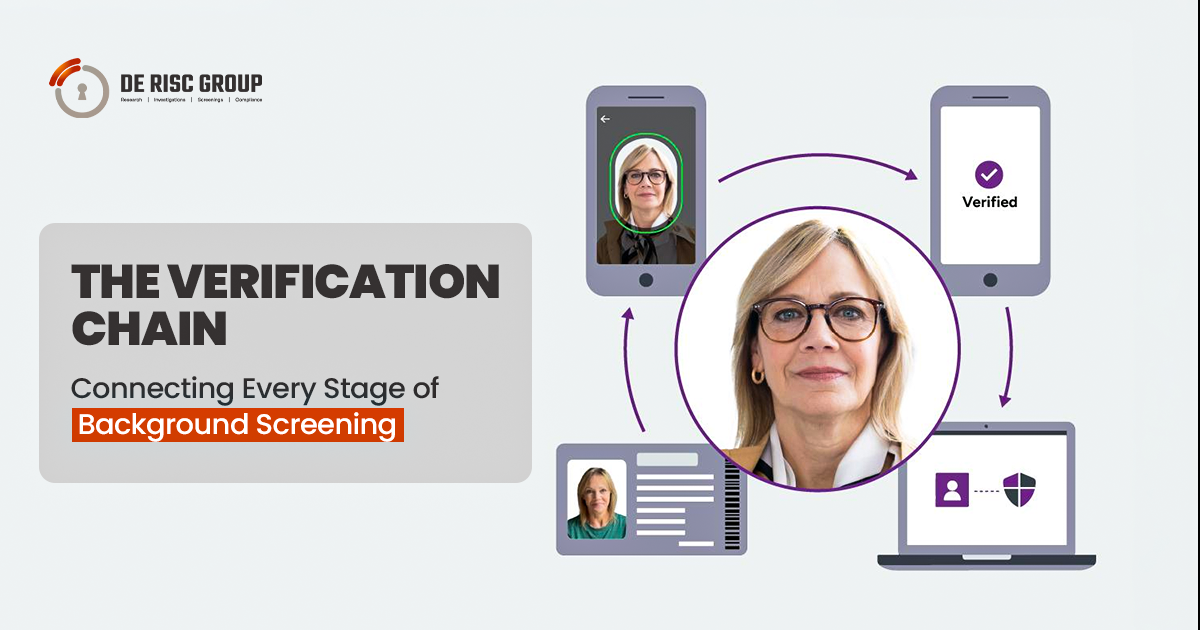
The Verification Chain: What Happens Behind Every Background Check?
A background check is often viewed as a straightforward exercise: a candidate provides their information, a screening provider conducts the necessary checks, and a report is delivered to the requesting organisation. Yet this apparent simplicity overlooks the extensive work that takes place between the initial request and the final result.
Behind a single verification report, there may be multiple institutions to contact, records to examine, sources to authenticate, discrepancies to investigate, and local procedures to navigate. In international screening, these challenges become even more pronounced as verification requirements, recordkeeping practices, and institutional processes vary considerably between countries.
What makes a background check reliable, therefore, is not simply the ability to retrieve information. It is the ability to establish its authenticity, assess its relevance, and report the findings accurately.
Understanding this process reveals why effective background screening depends on much more than databases and automated systems. It requires a connected chain of investigation, source validation, local expertise, and quality control.
Contents
- The Starting Point: Understanding What Needs to Be Verified
- The Source Behind the Information
- When Verification Becomes an International Investigation
- The Reality of Delays, Missing Records, and Difficult Verifications
- Discrepancies: Looking Beyond the Difference
- From Investigation to a Reliable Report
- Technology and Human Expertise: Why Both Matter
- Every Reliable Result Has a Process Behind It
- Frequently Asked Questions (FAQs)
The Starting Point: Understanding What Needs to Be Verified
Every background check begins with a request, but the information required to complete it is rarely as straightforward as it may appear.
An educational verification, for instance, involves more than confirming that a candidate attended a particular institution. Depending on the screening requirements, it may involve establishing the qualification awarded, the dates of attendance, the institution's recognition, and whether the submitted documentation corresponds with official academic records.
Employment verification presents a different set of considerations. Job titles, employment dates, positions held, and other relevant details may need to be established through former employers or authorised representatives.
The distinction between what a candidate declares and what an organisation needs to establish is important. Each verification has a specific objective, and understanding that objective determines the information required, the appropriate verification route, and the evidence needed to support the result.
Getting this foundation right helps prevent unnecessary delays and ensures that the investigation remains focused on the scope of the requested check.
The Source Behind the Information
One of the most important aspects of background screening is identifying where information comes from.
Not all information sources carry the same authority, and the availability of records does not automatically establish their reliability. A database entry, an institutional response, a government-issued record, and confirmation from an authorised representative may each serve a different purpose.
For educational checks, the most relevant source is generally the institution responsible for maintaining the academic record. Employment checks may require communication with the former employer or its authorized verification department. Criminal record checks, meanwhile, depend on the relevant government authorities, judicial systems, or legally accessible databases within a particular jurisdiction.
The challenge is that these sources operate differently around the world.
Some countries have centralized digital systems that allow information to be retrieved relatively quickly. Others rely on individual institutions, regional authorities, physical archives, formal applications, or in-person procedures. Even within the same country, access requirements can differ between institutions and types of verification.
Consequently, identifying the right source is not merely an administrative step. It is a fundamental part of establishing the credibility of the information being reported.
When Verification Becomes an International Investigation
The complexity of background screening becomes particularly evident when a candidate's history spans multiple countries.
An individual may have completed their education in one country, worked in another, and currently reside somewhere else. Each part of that history introduces a separate verification requirement, often involving different authorities, documentation standards, languages, and response procedures.
A verification process that takes a few days in one jurisdiction may require considerably longer in another. Some institutions respond through dedicated online portals, while others require signed consent forms, identification documents, formal correspondence, or follow-ups through local representatives.
Documentation can introduce further complications. Differences in name formats, transliteration, historical institution names, and recordkeeping practices may require additional examination before information can be matched confidently.
This is where local knowledge becomes particularly valuable. Understanding how institutions operate, which channels they recognise, and what documentation they require can make a significant difference to the verification process.
International screening is therefore not simply a matter of extending a domestic process across borders. It requires an understanding of the individual systems through which information is maintained, accessed, and confirmed.
The Reality of Delays, Missing Records, and Difficult Verifications
Not every verification produces an immediate response. In fact, some of the most demanding screening cases are those in which information is incomplete, institutions are unresponsive, or the usual verification channels are unavailable.
An institution may have changed its name, merged with another organisation, or closed its operations. Historical employment records may no longer be readily accessible. A government authority may have specific eligibility requirements or restrictions on releasing information to third parties.
In such situations, the process requires investigation beyond the initial request.
Additional documentation may need to be obtained, alternative authorised channels explored, and follow-ups conducted to establish whether the required information can be accessed. Where records are unavailable, this limitation must be recognised rather than replaced with assumptions.
The same principle applies when a verification cannot be completed. An institution's failure to respond does not establish that a qualification is false, just as an inaccessible public record does not establish the absence of a record.
A responsible screening process recognizes the difference between an adverse finding, an inconclusive result, and information that remains unverified.
This distinction protects both the organisation making the hiring decision and the individual whose background is being assessed.
Discrepancies: Looking Beyond the Difference
One of the most sensitive aspects of background screening is determining what a discrepancy actually means.
A difference between declared information and an independently obtained record may warrant further investigation, but it does not automatically indicate dishonesty or misrepresentation.
An employment date may differ because an organisation records the formal joining date rather than the commencement of a contract. An academic record may reflect a different award date from the date stated by a candidate. Names may appear differently because of transliteration, changes in legal names, or variations in institutional recordkeeping.
The important question is not simply whether two pieces of information differ. It is whether the difference is material, explainable, and supported by available evidence.
This is where professional judgement becomes essential. Additional clarification, supporting documents, or further communication with the relevant source may be necessary before a finding can be finalised.
Screening providers must avoid drawing conclusions beyond what the evidence establishes. Clear reporting should distinguish confirmed discrepancies from administrative variations and matters that could not be independently established.
The objective is not to interpret every difference as a warning sign. It is to provide organisations with accurate information on which they can make informed decisions.
From Investigation to a Reliable Report
The completion of individual checks does not necessarily mean the screening process is finished.
Before a report is delivered, the findings must be consolidated and reviewed. Information obtained from different sources needs to be assessed for consistency, supporting details examined, and unresolved matters documented.
Quality review plays an important role in ensuring that the final report accurately reflects the work conducted.
A reliable report should communicate more than a simple outcome. It should make clear which details were confirmed, where discrepancies were identified, which sources were consulted where relevant, and whether any limitations affected the verification.
Equally important is the distinction between the scope of a check and the conclusions it supports. A verification should never imply that information has been established beyond what the available source and evidence can demonstrate.
For organisations, this clarity is essential. Hiring and risk decisions often involve multiple stakeholders, and the screening report must provide an understandable account of the findings without creating unnecessary ambiguity.
Ultimately, the quality of a report depends on the quality of the investigation behind it.

Technology and Human Expertise: Why Both Matter
The background screening industry has evolved considerably with the introduction of digital databases, automated workflows, API integrations, and centralized verification platforms.
These developments have improved the way screening requests are managed. They can streamline data collection, reduce manual administrative work, facilitate information exchange, and support more efficient reporting.
However, technology cannot eliminate the complexities associated with verification.
Not every institution maintains digitized records. Not every authority provides online access, and not every discrepancy can be resolved through automated comparison. Some cases require direct communication, examination of supporting documents, or an understanding of local administrative practices.
Human oversight remains essential in these situations. Experienced professionals help assess the context behind discrepancies, navigate verification challenges, and ensure that findings are interpreted responsibly.
The future of background screening is not necessarily a choice between automation and manual investigation. It lies in bringing the two together: using technology where it adds efficiency while retaining human expertise where judgement, context, and direct investigation are required.
Every Reliable Result Has a Process Behind It
A background screening report may be the final deliverable, but it represents much more than a completed checklist. It reflects a sequence of decisions about where information should be obtained, how it should be verified, what to do when records are unavailable, and how findings should ultimately be presented.
As organisations continue to recruit internationally and operate across increasingly complex markets, the importance of a well-managed verification process will only grow.
The distinction between a basic information search and a dependable background check lies in the work behind the result: the credibility of the sources, the thoroughness of the investigation, the handling of discrepancies, and the accuracy of the final reporting.
At DE RISC Group, we understand that reliable background screening is built at every stage of the verification chain. Through a combination of international reach, local verification knowledge, structured processes, and careful review, we work to ensure that organisations receive findings they can assess with confidence.
Because a background check is only as dependable as the process behind it.
Frequently Asked Questions (FAQs)
1. What is the purpose of a background check?
A background check helps organisations verify information provided by candidates, including their educational qualifications, employment history, and other relevant records. It supports informed hiring decisions and helps identify discrepancies that may require further investigation.
2. What does the background verification process involve?
The process typically involves understanding the verification requirements, identifying reliable information sources, contacting relevant institutions or authorities, reviewing supporting documents, investigating discrepancies, and conducting a quality review before delivering the final report.
3. Why is source verification important in background screening?
Source verification helps establish the authenticity and reliability of information. Obtaining confirmation from relevant institutions, former employers, or authorised government sources provides a stronger basis for reporting findings.
4. How does international background screening differ from domestic screening?
International screening involves navigating different countries' legal requirements, institutional procedures, documentation standards, languages, and recordkeeping systems. Local knowledge and access to appropriate verification channels are often essential.
5. What happens if an institution does not respond to a verification request?
Additional follow-ups, alternative authorised channels, or supporting documentation may be explored. If the information cannot be established, the limitation should be clearly documented rather than replaced with assumptions.
6. Does a discrepancy in a background check automatically indicate fraud?
No. Discrepancies may result from administrative differences, name variations, recordkeeping practices, or differences in reporting dates. Further investigation is necessary before drawing conclusions.
7. What role does technology play in background verification?
Technology helps streamline screening workflows, automate administrative tasks, facilitate information exchange, and improve reporting efficiency. However, human expertise remains important for complex investigations, document assessment, and resolving discrepancies.
8. Why is quality control important in background screening?
Quality control ensures that findings are reviewed for accuracy, consistency, and completeness. It also helps ensure that the final report clearly communicates confirmed information, discrepancies, and any limitations encountered during verification.